Breeding
One Egg per Pokemon, ever; the secret letter; how IVs, nature and ability come down; and how to breed for what you want.
In short
- Every Pokemon can produce exactly one Egg in its lifetime. The charge is spent on a successful pairing and never comes back.
- Pairs are chosen from your party, at a Pokemon Centre, for a fee set by the Egg's potential.
- Each Pokemon has a hidden letter from A to F. Only matching letters pair, and you only learn by trying.
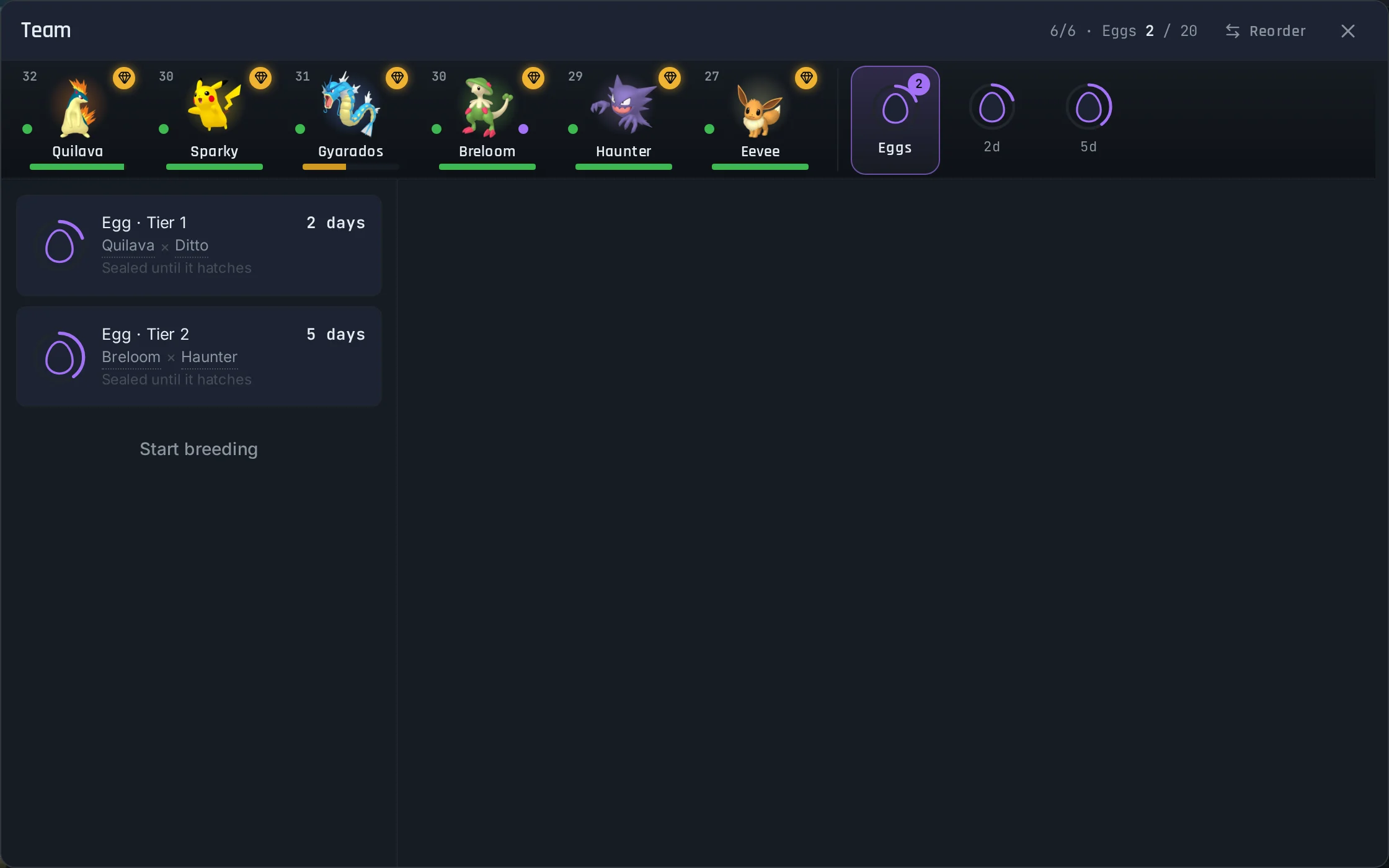
- The Egg is sealed. Nobody, you included, sees what is inside until it hatches, in real days.
The rule everything follows from
Making a pair
Go to any Pokemon Centre and open Breeding. The pair comes from your party, not from the PC, so finding a compatible pair means shuttling Pokemon in and out. The game checks, in this order: both are yours and in the party, they are two different Pokemon, neither has bred, neither is legendary or mythical, neither is in the no-eggs group, they share an egg group, one is male and one female or both are genderless and each holds a Kindred Herb, you are under the twenty-egg limit, and last, the letters match.
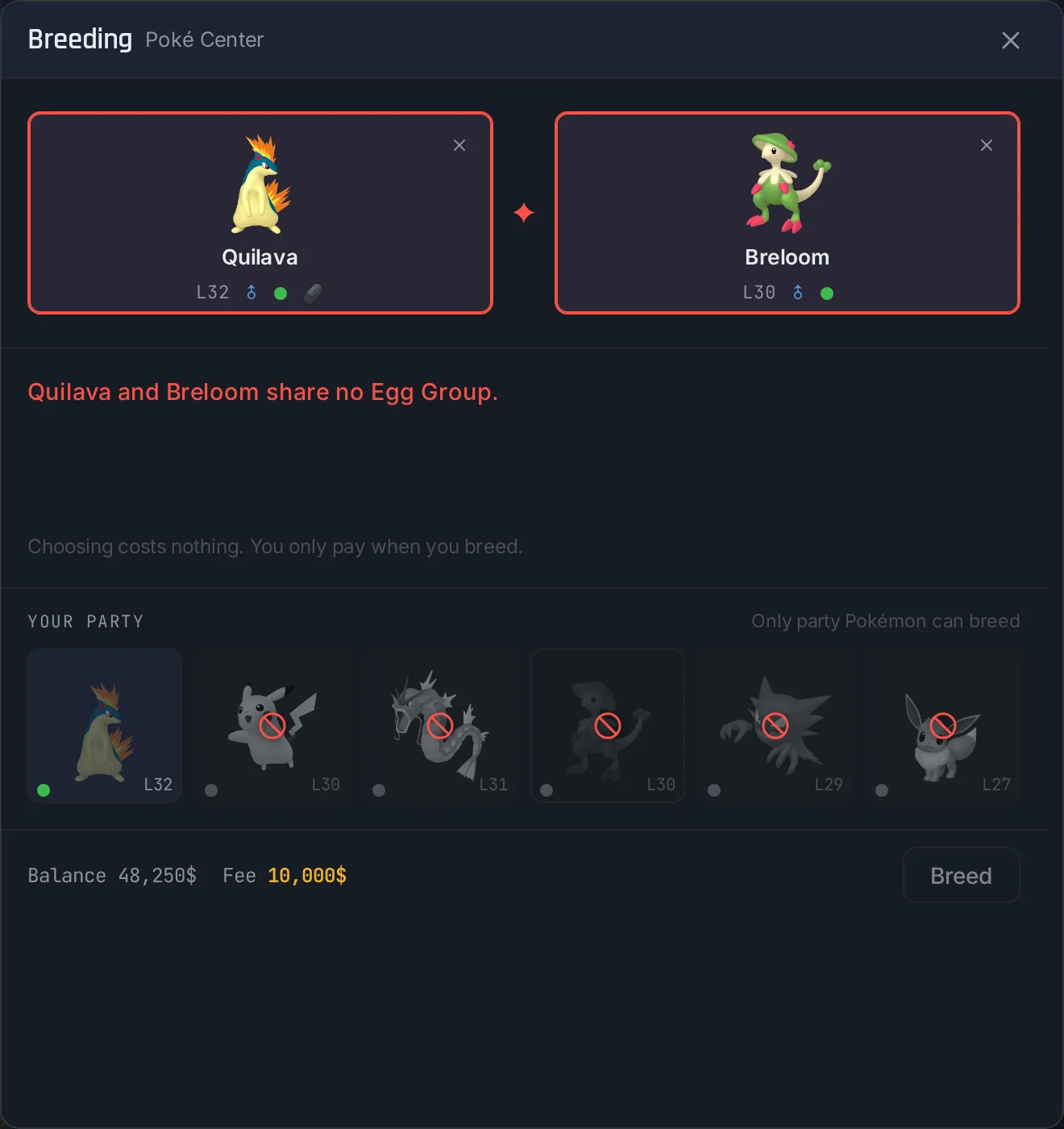
A rejection costs nothing, not money and not the charge. Roughly five pairs in six fail on the letter, and the message only ever says they do not get along; it never says which Pokemon, so a refused pair is a normal outcome and you simply swap one and try again.
872 of the 1,025 species can breed. Legendaries, mythicals and the no-eggs group, which includes every baby form, cannot be parents. Ditto is an ordinary Pokemon here and pairs with nothing special.
The fee and the hatch time
Both come from the Egg's potential: the highest base-stat total the species could reach by evolving. A Caterpie line is tier 1; a Beldum line is tier 5.
| Tier | Potential | Fee | Hatches in |
|---|---|---|---|
| 1 | under 400 | 1,000 | 3 days |
| 2 | 400 to 474 | 2,500 | 7 days |
| 3 | 475 to 524 | 5,000 | 12 days |
| 4 | 525 to 579 | 10,000 | 17 days |
| 5 | 580 and up | 20,000 | 21 days |
The pair's tier is the higher of the two parents'. Eggs hatch once a day, at 04:00 server time, and sit in your Team's Eggs tab until then. You may hold twenty at once.
What is in the Egg
Everything is rolled at the moment of breeding and sealed:
- Species. A coin flip between the two parents' families, then the root of that family. Charizard and Charizard give Charmander; Miltank and Tauros give either. Where a family has a baby form, you get the baby.
- IVs. For each stat separately, one parent's value is taken at random, then drifts: 10% up two, 20% up one, 40% unchanged, 20% down one, 10% down two, held between 0 and 31. Picking a parent per stat is what lets a line climb; a 31 is reachable and never quite safe.
- Nature is random. Ability is drawn from the species' pool: with no hidden-ability parent the Egg never has the hidden one, with one parent it is a coin flip, with two it is certain. Shiny is rolled like a wild encounter, with four times the rolls for each shiny parent: about 1 in 1,024 with one, 1 in 256 with two. The Egg also gets one of the species' egg moves, chosen at random, and the mother's Poké Ball.
How to breed for IVs
- Catch or trade for a parent with a 31 in the stat you want. Its Overview tab shows IVs.
- Pair it with anything compatible. Each stat takes a parent at random, so one good parent gives each stat a coin flip at inheriting the 31, with a 30% chance of drifting.
- Hatch, keep the best, pair it with the next good parent. The drift is symmetric, so a line improves by selection, not by stacking items.
- Expect it to take parents. Every generation spends two.
Breeding with another player
A pact needs no Pokemon Centre and no fee: both players stand in the same place, each offers one Pokemon from their party, and both confirm. The Egg goes to the owner of the female, or to whoever the pact names for a genderless pair. Any change to either offer clears both confirmations, so nobody confirms one thing and gets another. The letter is checked at the end exactly as for a solo pair, and a rejection leaves the pact open to swap and retry.
Eggs can be traded. Both sides see the parents, the tier and the days remaining, and neither sees inside, which is what keeps an Egg sale honest.